

Blog 47/ When Achievement Isn't Enough: A Juneteenth Reflection on Access, Opportunity, and the Post-DEI Era
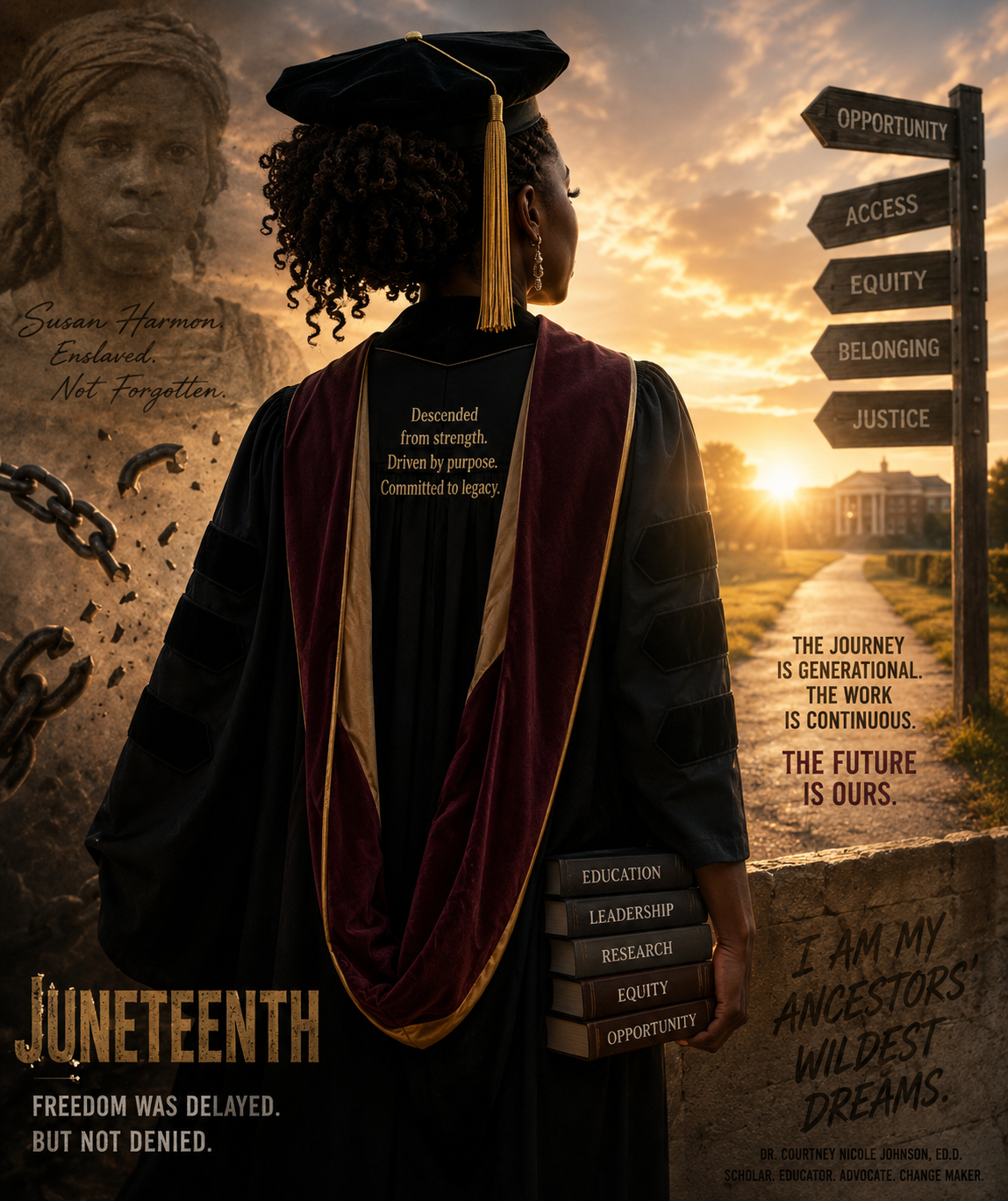
The path from Susan Harmon to Dr. Courtney Nicole Johnson is shorter than many people realize.
Every Juneteenth hits a little differently.
For some people, Juneteenth is a holiday.
For me, it is family history.
I can trace my lineage to Susan Harmon, an enslaved woman. Not a servant. Not a worker. Not someone who was "employed" under unfair conditions.
An enslaved woman.
Property.
A human being whose life, labor, body, and future were controlled by someone else.
Her son, Governor Gullatt, was fathered by the man who enslaved her, Charlie Gullatt. I cannot call that a relationship. History demands more honesty than that. Under chattel slavery, enslaved women did not possess the freedom to consent in the way we understand consent today.
That reality is uncomfortable.
It should be.
From Susan Harmon came generations of survivors. Through Peggy Cobb. Through Nettie Fay Yarbrough. Through countless sacrifices, losses, prayers, and acts of perseverance that will never appear in history books.
Sometimes people speak about slavery as though it belongs to another world.
For me, it does not.
The path from Susan Harmon to Dr. Courtney Nicole Johnson is shorter than many people realize.
Slavery is not ancient history in my family's story. It is part of the living legacy that shaped the generations that shaped me.
And eventually, there was me.
Dr. Courtney Nicole Johnson.
An African American woman from South Phoenix, Arizona.
The fifth of six children.
Raised by a single mother.
A girl who grew up in neighborhoods people often overlook.
A girl who was never supposed to be standing in front of national audiences presenting original scholarship.
Yet here I am.
Six months ago, on December 19, 2025, I earned my Doctor of Education degree from the illustrious Clark Atlanta University.
The highest educational credential available in my profession.
In the six months since earning my Doctor of Education degree, I have presented at four national conferences, spoken at a state legislative conference, participated in a United Nations-affiliated event, and pursued publication opportunities that continue to expand the reach of my scholarship.
Four.
Washington, D.C.
Arizona.
Philadelphia.
Austin.
I have shared research, contributed to conversations shaping higher education, and introduced audiences across the country to the Post-DEI Hollowing Phenomenon™.
By every traditional measure, this should be a season of celebration.
And yet, if I'm being honest, it has also been one of the hardest seasons of my life.
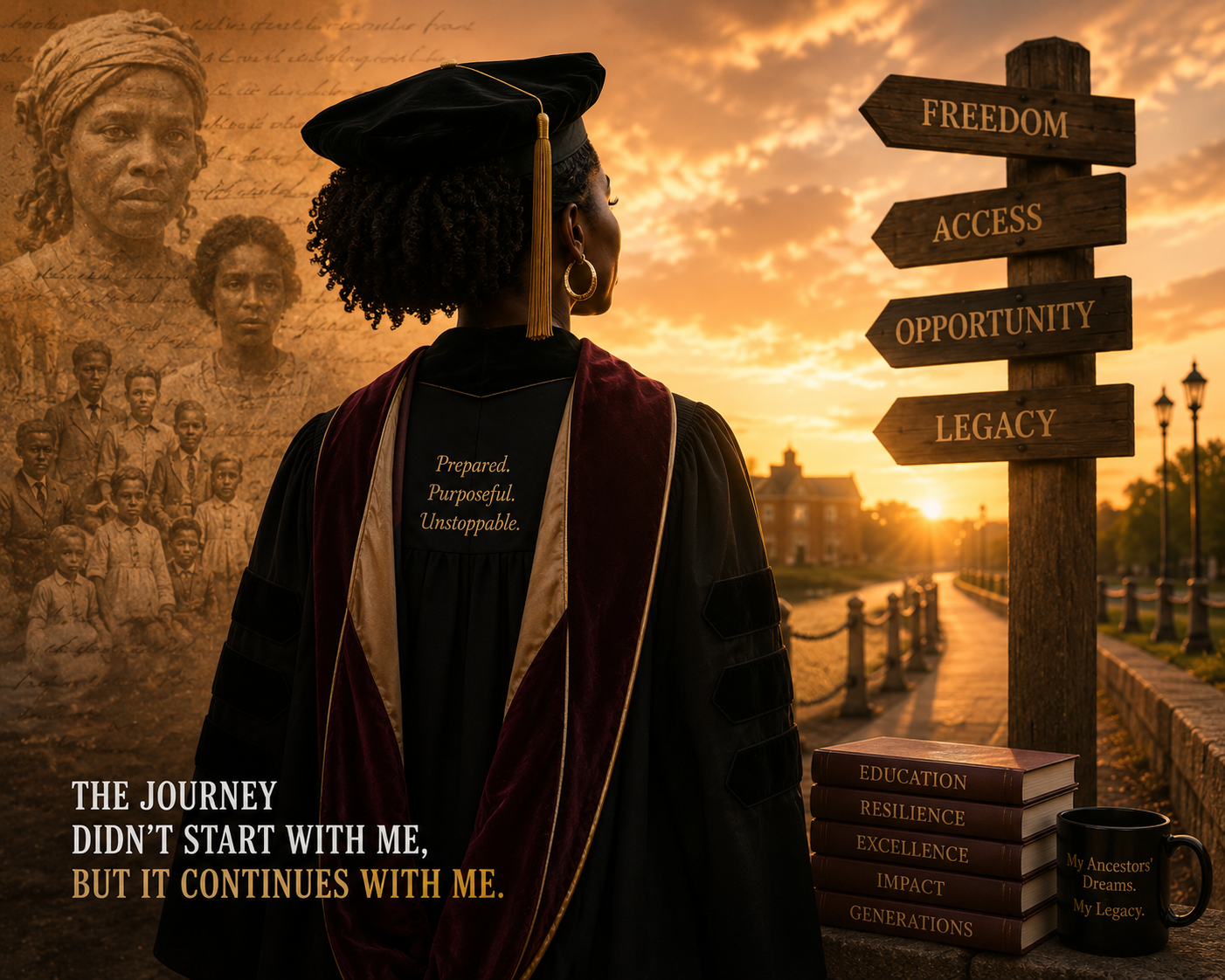
Sometimes achievement simply reveals where the barriers still exist.
That is the part nobody talks about.
People celebrate the hooding ceremony.
People congratulate you when they see "Dr." in front of your name.
People applaud the conference presentations.
People share the LinkedIn posts.
What they do not always see are the quieter realities that follow achievement.
The waiting.
The uncertainty.
The questions about what comes next.
The realization that accomplishment and opportunity do not always arrive at the same pace.
I never imagined that earning a doctorate would coincide with one of the most reflective seasons of my professional life.
But here we are.
And maybe that is why Juneteenth feels so relevant this year.
Because Juneteenth is not simply a celebration of freedom.
It is a reminder that freedom and access are not the same thing.
Freedom does not automatically create opportunity.
Freedom does not automatically create equity.
Freedom does not automatically create belonging.
My ancestors were denied freedom.
Generations after them fought for access.
Today, many of us continue to wrestle with questions of opportunity.
The form of the struggle changes.
The language changes.
The policies change.
But the questions remain.
Who gets access?
Who gets hired?
Who gets funded?
Whose expertise is valued?
Whose voice is welcomed?
And whose contributions are considered essential when institutions begin to change?
As someone who studies higher education, I cannot ignore the broader context surrounding these questions.
The dismantling of DEI initiatives has not occurred in a vacuum.
Programs have disappeared.
Positions have been restructured.
Offices have been renamed, reduced, or eliminated.
Language has been softened, redirected, or removed entirely.
Yet many institutions continue to speak about belonging while simultaneously reducing the infrastructure that once supported it.
I called this the Post-DEI Hollowing Phenomenon™ in my research.
What I did not fully anticipate was how often I would encounter conversations that reflected the very dynamics I had spent years studying.
As a scholar, I study these patterns.
As an African American woman who has spent her career in higher education, I notice them.
That does not mean every outcome is rooted in bias.
It does not mean every institution has bad intentions.
But it does mean we should be willing to examine how structural change shapes access, opportunity, and belonging in practice—not merely in principle.
There is a contradiction worth examining.
We continue to celebrate educational attainment as a pathway to opportunity.
Yet many highly educated professionals are asking difficult questions about where opportunity resides and who has access to it.
That contradiction deserves our attention.
This Juneteenth, I find myself holding gratitude and reflection at the same time.
I am grateful beyond words for the generations that came before me.
I am grateful for Susan Harmon.
I am grateful for every ancestor whose name I know and every ancestor whose name has been lost to history.
I am grateful to be living a life they could scarcely have imagined.
But I am also honest enough to acknowledge that achievement does not erase barriers.
Degrees do not erase barriers.
Expertise does not erase barriers.
Hard work does not erase barriers.
Sometimes achievement simply reveals where the barriers still exist.
Six months ago, I became Dr. Courtney Nicole Johnson.
That accomplishment can never be taken away.
Neither can the journey that brought me here.
This Juneteenth, I celebrate the distance my family has traveled.
From slavery to scholarship.
From property to professor.
From surviving to contributing.
From being denied an education to earning the highest level of one.
But I also remain committed to asking difficult questions about the future.
Because if education is truly meant to expand opportunity, then we must be willing to examine what happens when the promise of opportunity and the reality of access do not fully align.
My ancestors dreamed of freedom.
My generation was taught to dream of opportunity.
Perhaps the work before us now is ensuring those two things finally meet.

Perhaps the work before us now is ensuring those two things finally meet.
— Dr. Courtney Nicole Johnson
Remember, bold conversations, brewed fresh - one cup at a time!
Dr. Courtney Nicole Johnson
Founder of CourtneyCoffeeChats
Bold Conversations, Brewed Fresh.
Welcome to The Coffeehouse Collection - where higher education meets heart. Here, you will find Scholarly Sips, Courageous Cups, Life Latte Moments, and Freshly Brewed Reflections - bold conversation and personal insights brewed just for you!
