

Blog 46/ Fall 2026: When Consequences Become Observable
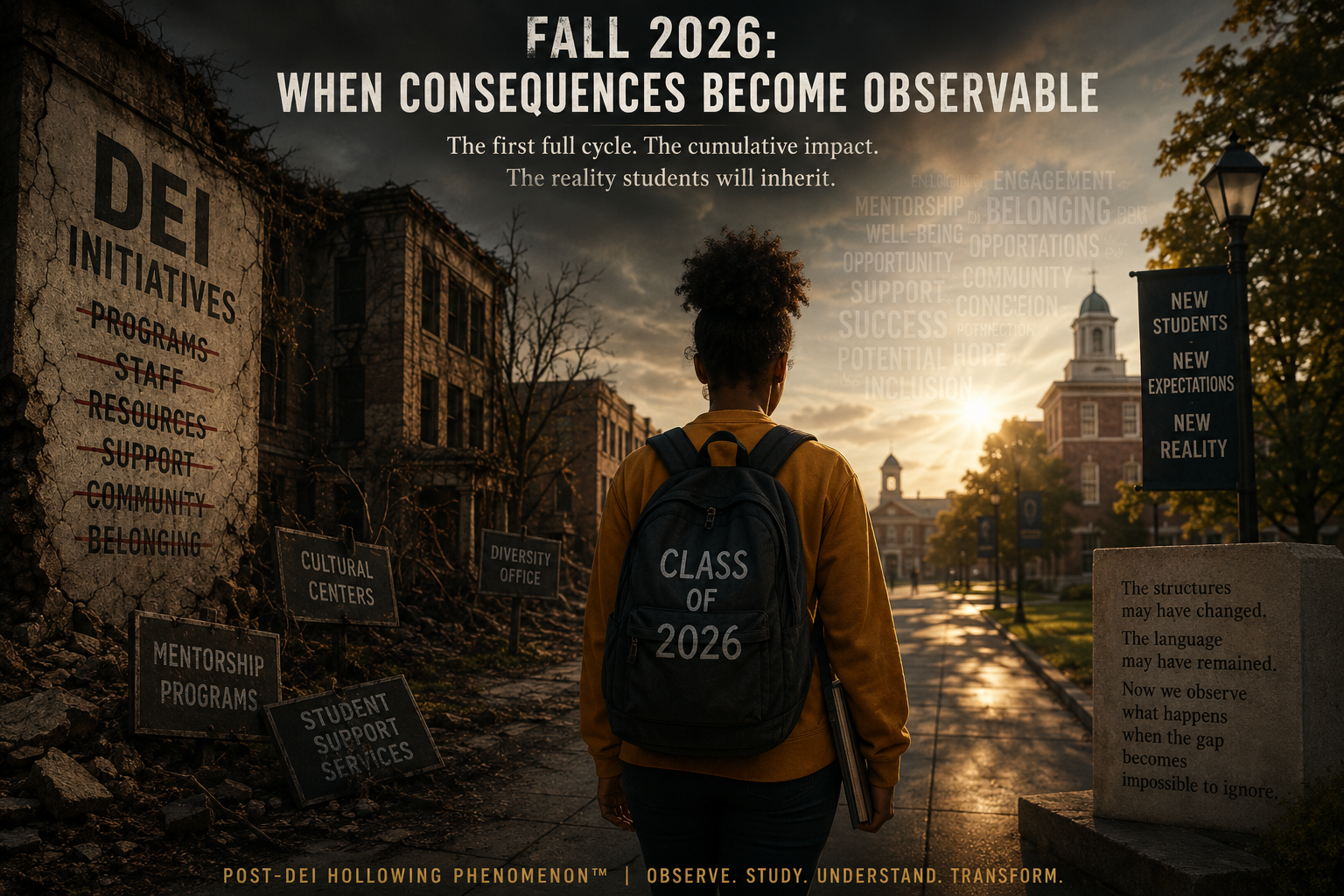
What previous students may recognize as loss, the Class of 2026 may simply experience as normal.
“Fall 2026 is not significant because the dismantling began. It is significant because the consequences have had time to mature.”
For more than a decade, I have experienced higher education from multiple vantage points.
As a faculty member, I have worked directly with students navigating the complexities of college life. As an enrollment and recruitment professional in Arizona, I have spent years helping students and families envision what is possible through higher education. As a researcher, I have studied student engagement, belonging, institutional climate, and the conditions that influence student success. As a recent Doctor of Education graduate from Clark Atlanta University and a national presenter, I have spent 2026 engaging audiences in conversations about institutional change and the consequences of Diversity, Equity, and Inclusion (DEI) retrenchment.
These observations do not emerge from a single campus, institution, or role.
They emerge from years spent examining how students experience higher education and how institutions create—or fail to create—the conditions necessary for students to thrive.
For much of 2025, higher education focused on immediate reactions.
Institutions reviewed executive orders. DEI offices were restructured, renamed, consolidated, or eliminated. Programs disappeared. Positions were reassigned or left unfilled. Public statements emphasized compliance, neutrality, and institutional adaptability. Across the nation, colleges and universities worked to navigate an increasingly complex political and legal landscape.
The conversation centered on change.
But Fall 2026 presents a different question.
What happens after the change?
Nearly two academic years removed from the earliest federal actions targeting DEI initiatives, colleges and universities are entering what may be the first full academic cycle shaped by the cumulative effects of those decisions. The headlines have faded. The restructuring has largely occurred. The public debate continues, but many institutions have already made significant operational adjustments.
What remains are the conditions created in their wake.
As the creator of the Post-DEI Hollowing Phenomenon™, I have argued that institutional change cannot be measured solely through organizational charts, office names, staffing structures, or public statements. The phenomenon describes something deeper: the growing gap between an institution's stated commitment to inclusion and its capacity to deliver the relational, cultural, and structural support necessary to sustain belonging.
Fall 2026 may become one of the first opportunities to observe the longitudinal consequences of that gap.
The question is no longer whether the ecosystem changed.
The question is what happens when institutions attempt to operate within the realities they have created.
The Incoming Class Will Know Only What Remains
The high school graduating class of 2026 arrives on college/university campuses with the same hopes students have always carried.
They seek community.
They seek mentorship.
They seek opportunities for growth, connection, leadership, and belonging.
What makes this moment unique is that many incoming students may never know what existed before.
They will not compare today's campus climate to that of 2023 or 2024. They may never know which programs were reduced, which mentoring initiatives disappeared, which cultural events were discontinued, or which staff members quietly exited the profession.
Instead, they will encounter the institution as it exists today.
What previous students may recognize as loss, they may simply interpret as normal.
That reality deserves careful attention.
Because when support structures disappear gradually, their absence often becomes invisible to those who never experienced their presence.
The Burden Has Shifted
One of the most significant consequences of institutional hollowing may be the transfer of responsibility from systems to individuals.
The work itself did not disappear.
Students still need support.
Students still seek belonging.
Students still experience loneliness, uncertainty, identity development, academic pressure, and transition challenges.
What has changed is the infrastructure available to address those needs.
Across higher education, faculty, advisors, counselors, cultural center professionals, student affairs practitioners, and countless others continue carrying extraordinary responsibilities on behalf of students. Yet many are doing so within institutions operating with fewer resources, fewer personnel, and diminished organizational capacity.
The burden did not vanish.
It shifted.
And the human cost of that shift is becoming increasingly difficult to ignore.
The Stress Test Begins
Institutional mission statements still promise engagement.
Strategic plans still emphasize belonging.
Recruitment materials still celebrate community.
Student success remains a central goal.
Yet Fall 2026 may represent a significant stress test for the systems tasked with delivering those outcomes.
Can institutions sustain engagement when trusted support structures have been weakened?
Can belonging flourish when students perceive fewer opportunities for meaningful connection?
Can retention goals remain unchanged while the relational infrastructure that often supports persistence becomes increasingly strained?
These questions are not accusations.
They are observations emerging from a rapidly evolving landscape.
The answers may differ across institutions.
But the questions themselves are becoming harder to avoid.
Why This Moment Feels Different
As someone who has spent years recruiting students and studying student success, one reality continues to stand out.
Students still arrive with the same expectations.
They want to be seen.
They want to matter.
They want to feel that they belong.
Those expectations have not disappeared.
What has changed is the environment into which many students are arriving.
Across the country, institutions are being asked to do more with less. Remaining faculty and staff continue working tirelessly to support students, often carrying responsibilities far beyond their formal roles. Yet many campuses are simultaneously navigating staffing reductions, programmatic changes, political pressures, enrollment challenges, workforce demands, and shifting institutional priorities.
The result is not always dramatic.
More often, it appears through strained systems, diminished capacity, practitioner burnout, reduced engagement opportunities, and widening gaps between institutional promises and student experiences.
From my perspective as both a researcher and practitioner, Fall 2026 feels significant not because it marks the beginning of these changes.
It feels significant because it may be the first semester in which many of their cumulative consequences become observable at scale.
The Fractures May Become More Visible
The consequences of hollowing are not always found in policy documents.
They often emerge in everyday moments.
A student unsure where to seek support.
A faculty member absorbing additional emotional labor.
An advisor managing an increasingly complex caseload.
A cultural center operating with fewer resources and/ or completely no longer operating.
A practitioner deciding that the profession they love is no longer sustainable.
A student choosing not to engage because participation feels uncertain.
These moments rarely generate headlines.
Yet collectively, they shape institutional culture.
Over time, they influence trust, engagement, persistence, and belonging.
What disappears quietly in one academic year often reappears loudly in the next.
Beyond Compliance
The conversation surrounding DEI has often been framed through legal, political, and administrative lenses.
Yet students experience institutions differently.
Students experience relationships.
Students experience access.
Students experience support.
Students experience presence—or absence.
The Post-DEI Hollowing Phenomenon™ suggests that the most significant consequences of institutional retrenchment may not always be found in organizational charts or policy documents.
They may be found in the everyday experiences of those navigating the institution itself.
That is why Fall 2026 feels pivotal.
Not because the dismantling began.
But because the consequences have had time to mature.
Final Sip
The first phase was removal.
The second phase was adjustment.
Fall 2026 may mark the beginning of something different: revelation.
Not because new policies are being announced.
Not because new headlines are being written.
But because institutions must now operate within the conditions they have spent the last two years creating.
Students will notice.
Faculty and staff will notice.
Communities will notice.
The question is whether institutions will notice as well.
The structures may have changed.
The language may have remained.
Now comes the opportunity to observe what happens when the distance between the two becomes impossible to ignore.
Remember, bold conversations, brewed fresh - one cup at a time!
Dr. Courtney Nicole Johnson
Founder of CourtneyCoffeeChats
Bold Conversations, Brewed Fresh.
Welcome to The Coffeehouse Collection - where higher education meets heart. Here, you will find Scholarly Sips, Courageous Cups, Life Latte Moments, and Freshly Brewed Reflections - bold conversation and personal insights brewed just for you!
