

Blog 36/ The Expanding Landscape of the Post-DEI Hollowing Phenomenon™

The structures are disappearing. The language remains.
The structures are disappearing.
The language remains.
Across the United States, institutions are entering a new era of organizational behavior surrounding diversity, equity, and inclusion (DEI). Offices are being renamed. Programs are quietly reduced. Policies remain in place even after courts intervene. Organizations are recalibrating internal structures in response to political pressure, regulatory uncertainty, and perceived financial risk.
Taken together, these developments illustrate the continued expansion of what I introduced in 2025 as the Post-DEI Hollowing Phenomenon™.
The Post-DEI Hollowing Phenomenon™ describes an institutional pattern in which organizations maintain the symbolic language of diversity while gradually dismantling the structural infrastructure that once supported diversity initiatives. In this environment, the outward appearance of commitment may remain visible even as the operational capacity for equity work steadily erodes.
Recent developments across universities, workplaces, and public policy environments suggest that this phenomenon is unfolding simultaneously across multiple institutional sectors.
Understanding these emerging patterns is critical for scholars, practitioners, and policymakers attempting to navigate the evolving landscape of diversity work in the United States.
Although much of the public conversation surrounding DEI focuses on institutional policy decisions, the consequences of these shifts ultimately reach students. When diversity infrastructure is hollowed out, the cultural centers, mentorship networks, and support programs that once fostered student engagement and belonging may quietly disappear alongside them.
Institutional Self-Censorship and the Chilling Effect
One of the most revealing dimensions of the Post-DEI Hollowing Phenomenon™ is the emergence of institutional self-censorship.
A recent development involving the University of Alaska illustrates this dynamic clearly. Although a federal court struck down a directive targeting diversity, equity, and inclusion initiatives, the University of Alaska Board of Regents indicated that it intends to continue maintaining the policy removing references to DEI across university programs and operations (Smith, 2026).
University officials cited concerns about potential federal funding risks and the broader regulatory environment as justification for continuing the policy despite the court ruling.
Faculty members responding during public testimony described a growing chilling effect on campus. Some educators reported feeling hesitant to discuss issues related to race, inequality, or identity in classroom environments even though such discussions remain lawful.
Within the framework of the Post-DEI Hollowing Phenomenon™, this situation reveals an important institutional dynamic: organizations may maintain restrictive practices not because they are legally required to do so, but because leaders perceive political or financial risk in restoring diversity-related initiatives.
In such environments, the dismantling of diversity infrastructure is accompanied by a cultural shift in which faculty, staff, and administrators begin to self-regulate their behavior in anticipation of potential scrutiny.
The hollowing becomes both structural and psychological.
Organizational Retreat Beyond Higher Education
The phenomenon is not confined to universities. Evidence suggests that similar patterns are emerging across the broader labor market.
A national survey conducted by the employment law firm Littler Mendelson found that regulatory developments related to DEI and immigration were among the most significant policy changes affecting employers over the past year (Golden, 2026).
More than one-third of surveyed employers reported reducing headcount within the past year, while an additional 30% indicated that they had paused or scaled back hiring.
While several policy factors contributed to these decisions, evolving federal scrutiny of DEI initiatives was cited as a key source of uncertainty.
In response, some organizations have begun scaling back diversity programming, reducing internal resources dedicated to inclusion efforts, or adjusting hiring strategies to avoid potential regulatory exposure.
These responses illustrate another dimension of the Post-DEI Hollowing Phenomenon™: organizational retreat.
In many cases, diversity initiatives are not eliminated through explicit mandates but are gradually reduced through internal administrative decisions designed to minimize perceived legal or political risk.
The result is a quiet erosion of diversity infrastructure occurring behind the scenes of organizational decision-making.
Institutional Rebranding and the Disappearance of DEI Language
Another pattern emerging nationally involves the institutional rebranding of diversity infrastructure.
Across higher education and public organizations, offices previously labeled Diversity, Equity, and Inclusion are increasingly being renamed under broader administrative categories such as belonging, community engagement, or student success.
While these offices may continue to exist organizationally, the explicit language of DEI is often removed from official titles, strategic plans, and public communications.
This form of administrative restructuring illustrates a subtle but significant dimension of the Post-DEI Hollowing Phenomenon™.
Rather than eliminating diversity initiatives entirely, institutions maintain the outward administrative structure while distancing themselves from the terminology that once defined the mission of the work.
The office remains.
The language disappears.

Diversity initiatives may continue internally, but their visibility within institutional communications quietly fades.
Program Quieting and Institutional Silence
In some cases, diversity programming itself is not eliminated but becomes less visible within institutional communications.
Events that once appeared prominently on university calendars may quietly disappear from official websites. Trainings previously promoted as institutional priorities may become optional or decentralized. Cultural programming may continue internally but without the marketing support that once signaled institutional endorsement.
Within the framework of the Post-DEI Hollowing Phenomenon™, this development can be understood as program quieting.
The work itself may continue in limited form, yet its visibility within institutional narratives fades.
Public language retreats.
Institutional silence expands.
Compliance Replacing Equity Frameworks
A final dimension of the phenomenon involves a shift in how institutions frame diversity work altogether.
In some environments, diversity offices are replaced not by new inclusion initiatives but by compliance-oriented administrative frameworks focused on civil rights obligations and regulatory adherence.
This shift reframes diversity work from a mission-driven effort to promote equity and belonging into a legal compliance function designed primarily to mitigate institutional risk.
The philosophical orientation of the work changes dramatically.
Where institutions once asked:
How can we create environments where all students belong?
They now increasingly ask:
How can we ensure that our policies meet minimum regulatory standards?
This transformation reflects the operational dimension of the Post-DEI Hollowing Phenomenon™.
The focus moves from proactive equity work to reactive compliance management.
The Expanding Dimensions of the Post-DEI Hollowing Phenomenon™
Taken together, recent developments across public policy, higher education governance, and organizational behavior suggest that the Post-DEI Hollowing Phenomenon™ is unfolding through several interconnected dimensions.
Structural Hollowing
The removal of diversity offices, programs, and institutional roles dedicated to equity work.
Psychological Hollowing
The emergence of chilling effects in which individuals hesitate to engage in diversity-related conversations due to perceived political or professional risk.
Operational Hollowing
Institutional decisions that reduce hiring, funding, or resources dedicated to diversity initiatives in response to regulatory uncertainty.
Symbolic Hollowing
The continued use of diversity language or symbolic commitments despite the gradual dismantling of the structures that once operationalized those commitments.
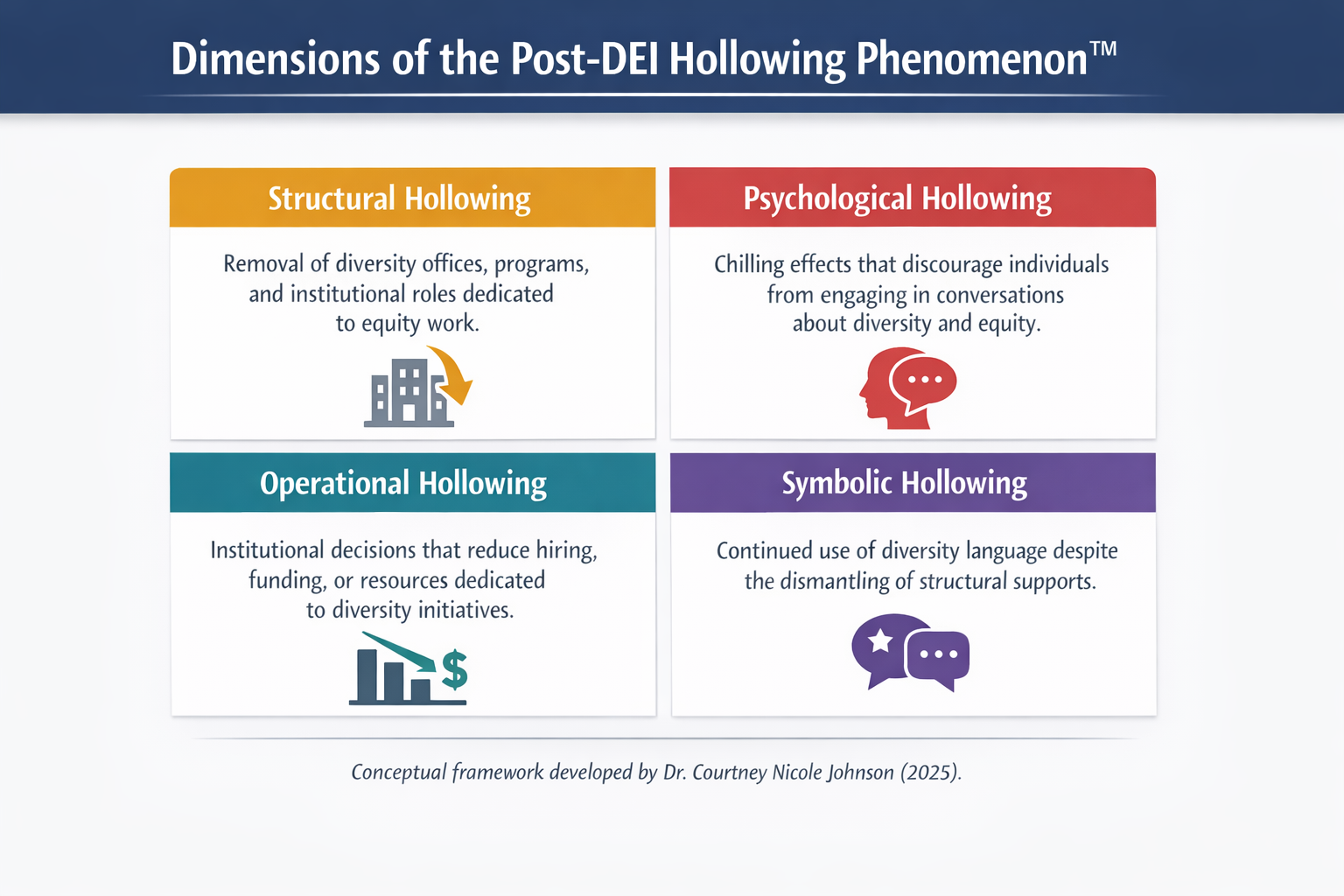
Figure: Dimensions of the Post-DEI Hollowing Phenomenon™.
Recognizing these dimensions allows scholars to better understand how institutions adapt during periods of policy transition and political scrutiny surrounding diversity initiatives.

Understanding the Post-DEI Hollowing Phenomenon™ will be critical as institutions navigate the shifting terrain of diversity policy and practice.
Looking Ahead
The national conversation surrounding diversity, equity, and inclusion is far from settled.
If anything, it is entering a more complex phase in which institutional change may occur not only through visible policy decisions but also through quieter organizational behaviors: renaming offices, reducing programming visibility, recalibrating hiring strategies, and reframing equity work through the language of compliance.
These developments suggest that the Post-DEI Hollowing Phenomenon™ may represent a broader transformation in how institutions navigate diversity in politically contested environments.
As I prepare to present research related to this phenomenon at the upcoming conference of the National Association of Diversity Officers in Higher Education in Philadelphia, documenting these emerging patterns remains an important task for scholars seeking to understand the evolving institutional landscape of diversity work in the United States.
The language of diversity may continue to appear in mission statements and strategic plans.
But the deeper question remains:
What happens when the structures that once sustained those commitments quietly disappear?
References
Golden, R. (2026, March 12). AI trailed DEI, immigration in 2025 compliance impact, employers say. HR Dive. https://www.hrdive.com
Smith, C. (2026, February 24). UA Board of Regents to continue anti-DEI policy despite federal court ruling. Alaska Beacon. https://alaskabeacon.com
Remember, bold conversations, brewed fresh - one cup at a time!
Dr. Courtney Nicole Johnson
Founder of CourtneyCoffeeChats
Bold Conversations, Brewed Fresh.
Welcome to The Coffeehouse Collection - where higher education meets heart. Here, you will find Scholarly Sips, Courageous Cups, Life Latte Moments, and Freshly Brewed Reflections - bold conversation and personal insights brewed just for you!
