

Blog 26/ What Remains When Support Becomes Conditional

Support rarely disappears. It becomes conditional.
There is a difference between support that is offered—and support that is sustained.
In the wake of institutional DEI retreat, much attention has focused on what has been removed: programs paused, positions dissolved, language softened, commitments withdrawn. But the more revealing shift is not always what disappears. It is what remains, reshaped by condition.
This is where the next phase of the Post-DEI Hollowing Phenomenon™ becomes visible—not through absence alone, but through conditionality.
Support does not vanish outright.
It becomes selective.
Qualified.
Contingent.
And in that shift, belonging, protection, and care quietly change form.
Conditional Belonging
Belonging, when institutionalized, is often framed as inclusive by default. Yet in post-DEI contexts, belonging increasingly operates under terms that are unspoken but well understood.
Students and professionals are welcomed—so long as they do not disrupt the narrative.
Participation is encouraged—as long as it remains celebratory rather than critical.
Presence is affirmed—provided it does not call attention to structural inequities still in place.
This is conditional belonging: a form of inclusion that rewards alignment over authenticity.
Under these conditions, individuals learn quickly what is permissible to express and what must be withheld. Belonging becomes performative rather than relational. It is not rooted in shared responsibility, but in behavioral compliance.
What remains is access without assurance—and visibility without safety.
Conditional Protection
Protection is often assumed to accompany institutional affiliation. Yet protection, like belonging, can become conditional in moments of institutional contraction.
Support systems remain nominally intact—policies exist, reporting mechanisms remain, statements are still published. But the response to harm is increasingly filtered through risk management rather than care.
Who is protected depends on:
Who is perceived as low risk
Who is considered manageable
Whose concerns can be addressed without institutional discomfort
Those who raise questions about equity, transparency, or accountability may find that protection recedes—not overtly, but subtly. Concerns are redirected. Timelines extend. Processes stall. Language shifts from response to restraint.
Conditional protection does not deny harm outright; it delays resolution long enough to discourage pursuit.
What remains is procedure without trust.
Conditional Care
Care, in its truest form, is anticipatory. It recognizes need before crisis. It is sustained even when inconvenient.
Conditional care, by contrast, is transactional.
Resources are available—if one knows how to navigate the system.
Support is offered—if the request aligns with institutional priorities.
Empathy is extended—as long as it does not require institutional change.
In post-DEI environments, care often becomes individualized rather than systemic. Responsibility is shifted to the recipient: resilience is praised, adaptability is celebrated, and coping replaces accountability.
The institution remains intact, while individuals are asked to adjust.
What remains is wellness language without structural support.
What This Reveals
The Post-DEI Hollowing Phenomenon™ is not solely about removal—it is about redefinition.
Support persists, but only under conditions that preserve institutional comfort.
Belonging is offered, but only within controlled boundaries.
Care exists, but primarily as a response, not a commitment.
These conditions reshape engagement. They teach students and professionals what is safe to say, when silence is rewarded, and how much truth an institution is willing to hold.
And yet—what also remains is discernment.
Individuals recognize the shift. They adapt not because the system is just, but because survival requires it. Engagement continues, but often with caution. Trust is extended, but provisionally.
Why This Moment Matters
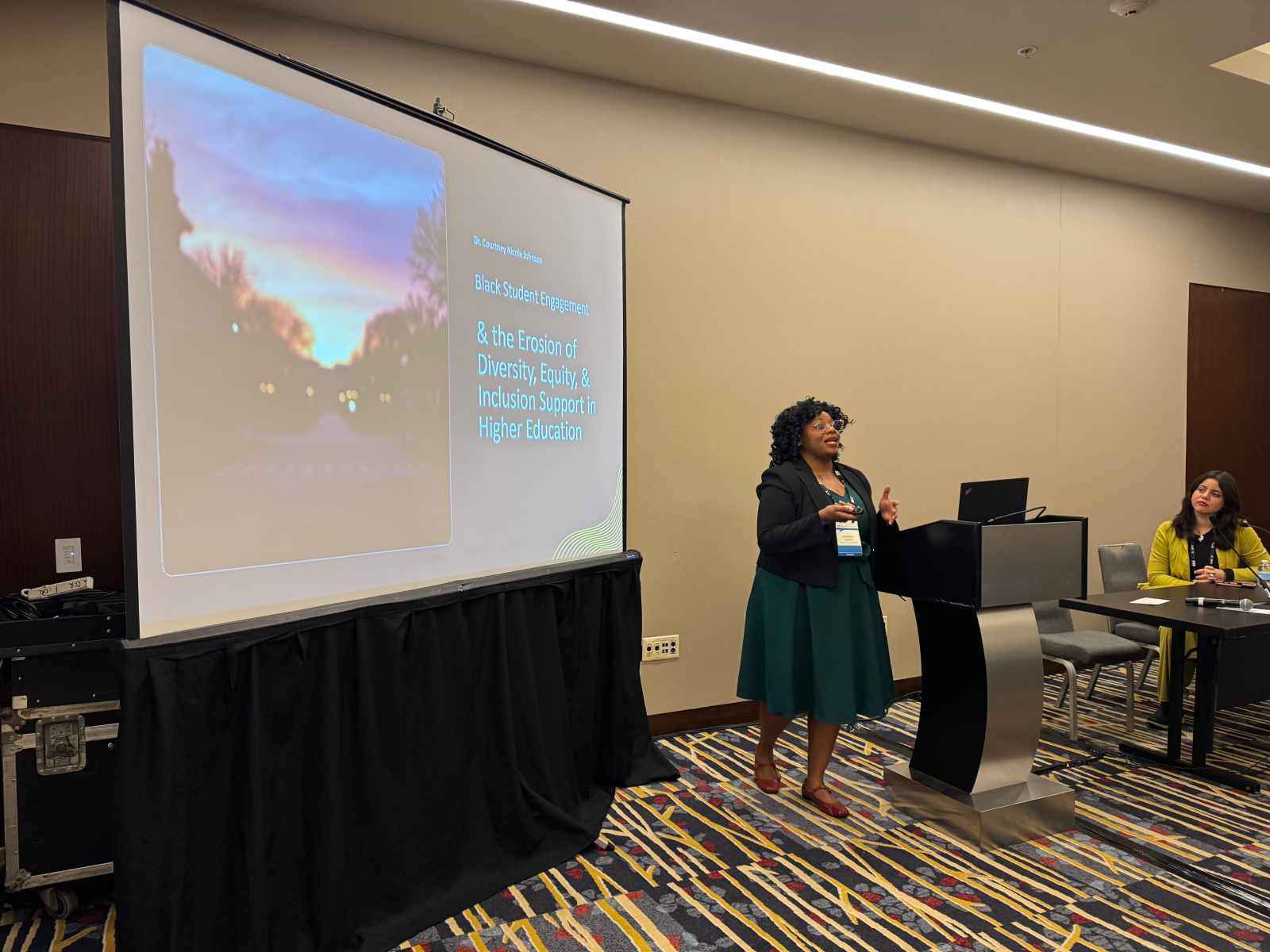
From dissertation defense to national dialogue. This presentation at the AAC&U Annual Meeting 2026 marks one of the moments where my research entered the public sphere.
As institutions move forward, the question is no longer whether support exists—but under what conditions it is granted.
Conditionality may stabilize systems in the short term, but it erodes credibility over time. Institutions that rely on silence to sustain cohesion risk hollowing out the very engagement they claim to value.
What remains, ultimately, is a choice.
To move beyond conditional support requires more than restored language or revised frameworks. It requires institutions willing to sustain care, protection, and belonging—even when doing so is uncomfortable.
Anything less is not support—it is management.
And management cannot substitute for responsibility.
Remember, bold conversations, brewed fresh - one cup at a time!
Dr. Courtney Nicole Johnson
Founder of CourtneyCoffeeChats
Bold Conversations, Brewed Fresh.
Welcome to The Coffeehouse Collection - where higher education meets heart. Here, you will find Scholarly Sips, Courageous Cups, Life Latte Moments, and Freshly Brewed Reflections - bold conversation and personal insights brewed just for you!
