

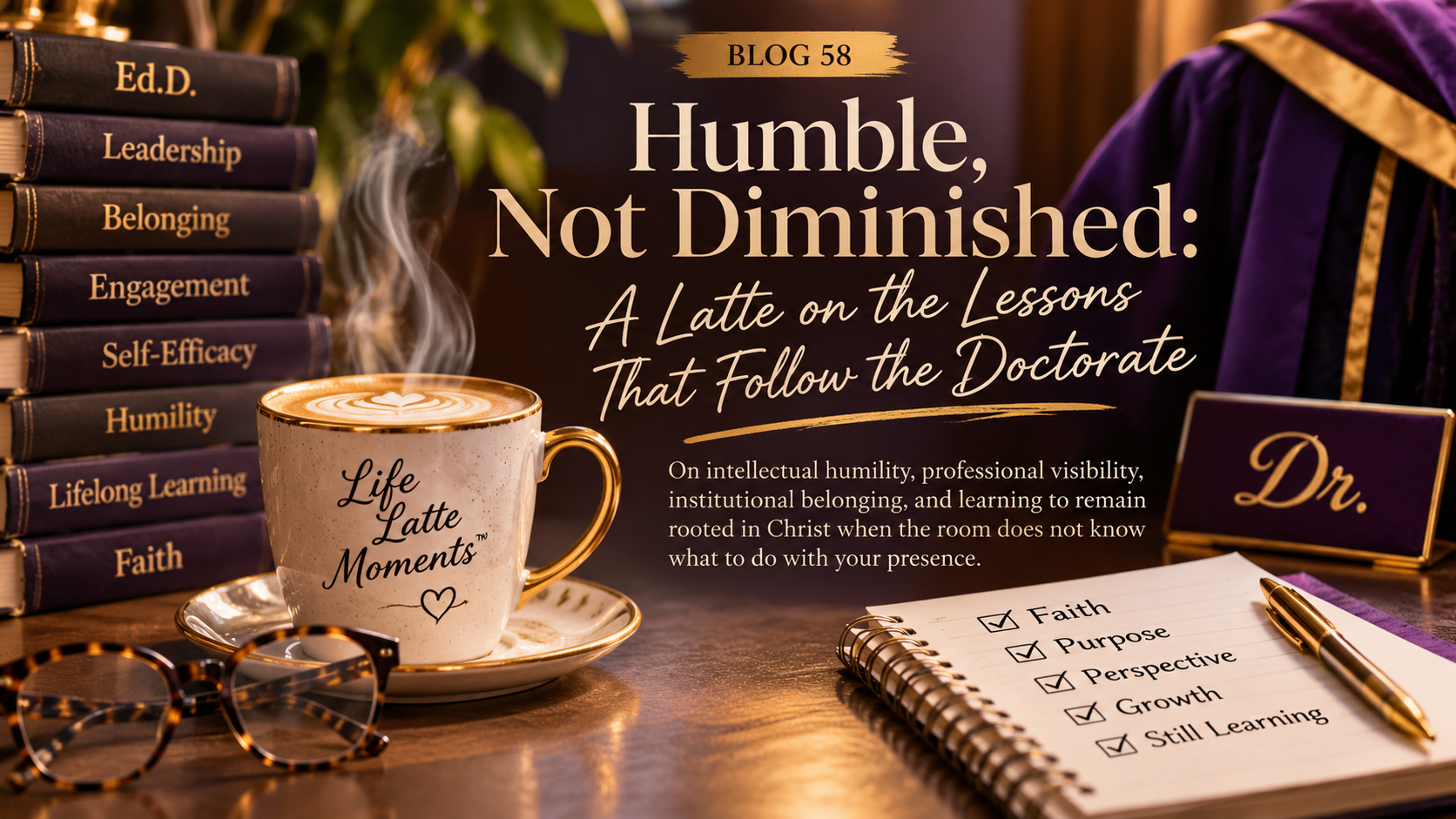
On intellectual humility, professional visibility, institutional belonging, and learning to remain rooted in Christ when the room does not know what to do with your presence.
There is something fascinating about becoming the person you prayed to become and discovering that the world does not always know what to do with you once you arrive.
Nearly eleven months after officially earning my Doctor of Education, I am still learning.
Not necessarily about research methodologies, theoretical frameworks, scholarly writing, or the academic disciplines that have shaped my intellectual development. Although, as a lifelong learner, I remain deeply committed to expanding my knowledge in those areas.
I am learning about people.
I am learning about professional environments.
I am learning about the difference between being visible and being welcomed, between holding credentials and being afforded credibility, and between possessing intellectual confidence and being perceived as a threat.
Most importantly, I am learning about humility.
Not the manufactured humility that requires accomplished individuals to minimize their achievements so others can remain comfortable.
Not the performative humility that demands we apologize for occupying spaces we worked diligently to enter.
And certainly not the version of humility that expects women of color to make themselves smaller, quieter, or less visible.
I am talking about the humility that comes from knowing who I am, recognizing Whose I am, and understanding that even with every degree, title, and accomplishment, I remain a student of life.
I am humble. But I will not be diminished.
And there is a difference.
The Doctorate Did Not Change. The Conversations Did.
Since earning my Ed.D., I have encountered some interesting conversations.
People have asked what kind of doctor I am. Others have volunteered explanations about why they never pursued a doctorate, why their own attempts were unsuccessful, or why they ultimately decided that doctoral education was not for them.
Sometimes these exchanges are genuinely thoughtful.
I welcome curiosity, meaningful dialogue, and opportunities to discuss education. I recognize that the pursuit of a doctorate is not everyone's aspiration, nor should it be.
But other conversations have felt less like curiosity and more like unsolicited comparisons.
I have found myself listening to explanations I never requested, defending nothing, and wondering why my educational attainment has prompted someone else to justify their own journey.
Let me be clear.
My doctorate is not a commentary on anyone else's educational decisions.
My accomplishment does not invalidate someone else's path. My professional title does not make another person's contributions less meaningful. And my years of academic preparation do not suggest that I possess all the answers.
I did not enter these spaces asking people to compare themselves with me.
In many instances, I was simply existing.
Yet there is something worth examining about how certain forms of accomplishment are received, particularly when those accomplishments are embodied by women of color.
The legitimacy of our expertise can become a subject of interrogation. Our confidence may be interpreted as arrogance. Our professional identities can become invitations for unsolicited scrutiny.
Not every question is an attack. Not every awkward exchange reflects insecurity. And I cannot claim to know the private motivations of people who interact with me.
But I also do not have to dismiss patterns I have experienced simply because their underlying causes are not always immediately visible.
I can recognize an interaction as uncomfortable without pretending to know everything about the person behind it.
That distinction is part of intellectual humility.
And it is something I continue to practice.
When Professional Visibility Does Not Produce Belonging
There is another dimension of this journey that has been equally illuminating.
I have worked in environments where the atmosphere has felt cold, uninviting, and, at times, isolating.
I have experienced moments of being ignored, overlooked, or singled out without a clear explanation.
And what makes some of those experiences particularly interesting is how little interpersonal interaction actually occurs.
I come to work.
I fulfill my responsibilities.
I communicate when necessary.
I collaborate when the work requires it.
I do not need a lunch companion, an invitation into every conversation, or a personal friendship with every colleague.
I am entirely comfortable maintaining professional boundaries.
But professional distance and professional exclusion are not interchangeable.
There is a difference between not being friends with someone and failing to extend basic collegial respect.
A workplace does not have to function like a social club to be humane.
A person should not have to become personally familiar to be treated with professional courtesy.
And genuine engagement should not depend upon whether someone fits comfortably within an existing social circle.
There have been occasions when colleagues have passed by my workspace, appeared to notice me, but said very little. Other interactions have involved unexpected comments or exchanges that left me uncertain about how to interpret them.
I do not pretend to know what every silence means.
Some people are naturally reserved. Others may be preoccupied, uncomfortable with small talk, or simply navigating their own circumstances.
But when interpersonal distance becomes a recurring part of one's professional experience, it raises questions worth considering.
What does belonging actually look like in an organization?
Can someone be institutionally included while remaining relationally disconnected?
Can a person occupy a legitimate position within an organization without experiencing meaningful collegial engagement?
And what happens when visibility increases, but connection does not?
These are not merely personal questions.
They are also intellectual ones.
A Latte With the Post-DEI Hollowing Phenomenon™
For those familiar with my scholarship, these reflections may sound strikingly familiar.
My research has examined Black student engagement, sense of belonging, and self-efficacy within predominantly White institutional environments during periods of diversity, equity, and inclusion retrenchment.
Through that work, I developed the Post-DEI Hollowing Phenomenon™, a framework for examining how institutional structures, operational decisions, psychological experiences, and symbolic commitments can become disconnected from the actual experiences of the people institutions claim to support.
The phenomenon considers structural, psychological, operational, and symbolic dimensions of institutional hollowing.
At its core is a difficult question:
What happens when an institution continues to include people in its formal structures while the conditions necessary for meaningful engagement, belonging, and agency become increasingly fragile?
Although my research emerged from the experiences of Black college students, the questions it raises have implications for how we think about organizational life more broadly.
And nearly eleven months beyond my doctoral journey, I find myself reflecting on those questions through another lens.
My own.
I want to be careful here.
A personally uncomfortable workplace is not automatically evidence of DEI retrenchment. An awkward interaction is not proof of institutional discrimination. And the experience of professional isolation, by itself, does not establish that the Post-DEI Hollowing Phenomenon™ is occurring.
As a researcher, I have an obligation to distinguish lived experience from systematically established findings.
But personal experience can generate important questions.
And the questions are compelling.
Engagement is more than presence.
An employee can attend meetings, complete assignments, respond to requests, and fulfill professional obligations while experiencing little meaningful interpersonal engagement.
Belonging is more than institutional membership.
An individual can possess an official title, occupy a designated workspace, and appear on an organizational chart without necessarily feeling welcomed, valued, or socially connected.
Self-efficacy is more than external approval.
A person may maintain confidence in their ability to perform professional responsibilities even when the surrounding environment offers limited affirmation or encouragement. At the same time, sustained exclusion or restricted opportunities to exercise agency can create barriers that individual confidence alone cannot overcome.
That final distinction matters.
Self-efficacy, as a psychological construct, concerns beliefs about one's capacity to carry out actions and achieve particular outcomes. It should not be confused with popularity, universal acceptance, or the approval of colleagues.
Likewise, belonging is not synonymous with friendship.
And engagement is not simply a measure of how many conversations take place during the workday.
These concepts are more complex.
Their complexity is precisely why I remain committed to studying them.
I am not suggesting that every environment where I experience disconnection represents institutional hollowing.
I am recognizing that the very questions I have dedicated my scholarship to examining continue to illuminate how I interpret organizational life.
The researcher in me asks what the environment is producing. The woman in me acknowledges how the environment feels. And the Christian in me asks how I can remain faithful, discerning, and grounded while navigating it.
All three perspectives deserve consideration.
Being Seen Is Not the Same as Being Known
We live in an era when professional visibility can exist almost entirely without meaningful human interaction.
Someone can read a biography, visit a website, review a publication, or scroll through a social media profile without ever having a substantive conversation with the person behind the information.
I have become increasingly aware that people may encounter my professional identity digitally before ever engaging with me personally.
There is nothing inherently wrong with that.
Public scholarship is intended to be accessible. Professional biographies provide useful context. And social media allows people to encounter ideas, accomplishments, and experiences beyond their immediate networks.
But consuming information about someone is not the same as understanding them.
A Google search cannot tell you what it cost someone to become who they are.
It cannot reveal every sacrifice, disappointment, prayer, or private moment of perseverance.
It cannot adequately communicate the grief associated with changing relationships or the loneliness that may accompany unfamiliar seasons.
And it certainly cannot tell the complete story of someone's character.
People may know what I have accomplished without knowing me.
They may encounter my credentials without understanding the experiences that shaped them.
They may observe my work without ever choosing to engage with it.
That is their prerogative.
I have learned not to equate online attention with genuine relationship, just as I have learned not to interpret the absence of public engagement as evidence of someone's private intentions.
Visibility is not intimacy. Observation is not connection. Recognition is not belonging.
Those distinctions are worth remembering, especially in a world that sometimes mistakes access to information for access to a person.
Humility Is Not an Invitation to Make Me Smaller
One of the most important lessons I am learning is that humility and diminishment are not the same thing.
I believe deeply in remaining teachable.
I am humbled by the brilliance of other scholars, educators, leaders, practitioners, and individuals whose life experiences have equipped them with knowledge I do not possess.
I welcome opportunities to learn from people who challenge my thinking, introduce unfamiliar perspectives, and encourage me to examine what I believe I know.
I recognize that possessing an advanced degree does not exempt me from error.
It does not guarantee wisdom.
It does not automatically produce maturity, discernment, kindness, or character.
Those qualities require ongoing cultivation.
But intellectual humility should never be mistaken for an obligation to surrender intellectual credibility.
I can acknowledge what I do not know without pretending I do not know what I know.
I can remain curious without becoming apologetic about my expertise.
I can celebrate someone else's accomplishments without minimizing my own.
I can receive constructive criticism without accepting disrespect.
And I can exercise confidence without declaring myself superior.
For women of color, these distinctions carry additional significance.
The expectations placed upon our professional conduct do not always operate independently of race and gender. Scholarship on workplace inequality, racialized expectations, and gendered perceptions of authority provides important reasons to examine whose confidence is welcomed, whose expertise is questioned, and whose professional legitimacy is treated as conditional.
These dynamics should not be reduced to assumptions about the motives of every individual we encounter.
But neither should they be ignored simply because they are uncomfortable to discuss.
There is a difference between accountability and intimidation.
Between professional inquiry and unnecessary interrogation.
Between encouraging growth and expecting someone to diminish themselves for the convenience of others.
I did not work this hard to become educated only to pretend that my education does not exist.
And I do not believe God entrusted me with gifts, opportunities, and intellectual responsibilities so that I could bury them beneath someone else's expectations of what humility should look like.
The responsibility is not to become less.
It is to steward more faithfully what I have been given.
The Unanticipated Terms of Answered Prayers
There is a deeply personal dimension to this season that extends beyond professional identity.
Over the past several years, I have watched God answer prayers with remarkable specificity.
Not vague aspirations.
Not distant possibilities.
Specific requests.
Some were quite literally at the top of my list.
And I received them.
Opportunities I once imagined became realities. Doors opened. My scholarly work expanded. Responsibilities increased. My life began to resemble things I had previously brought before God in prayer.
Yet the terms and conditions were not exactly what I anticipated.
I did not expect to feel this lonely.
I did not expect certain relationships to change.
I did not expect that entering new spaces would sometimes leave me feeling more disconnected than I had felt before.
And I certainly did not expect that some of my greatest accomplishments would coexist with some of my quietest and most emotionally challenging seasons.
But they have.
I have grieved friendships, familiar environments, and versions of life that no longer look the way they once did.
I have entered spaces where I have struggled to feel connected to the people around me.
I have experienced periods of exhaustion, discomfort, and uncertainty while simultaneously recognizing that I am living within answers to prayers I once desperately hoped would be fulfilled.
I received what I prayed for. I simply did not anticipate everything that would accompany receiving it.
And that realization has humbled me.
Because gratitude and grief are not mutually exclusive.
I can be thankful and tired.
Blessed and lonely.
Accomplished and uncertain.
Confident in my calling while still learning how to navigate its responsibilities.
I do not believe I have to deny my emotions to demonstrate gratitude for God's faithfulness.
Nor do I believe that every difficult circumstance must be interpreted as evidence that I have stepped outside His will.
I continue to trust His direction.
And in these quieter, sometimes uncomfortable places, I am learning to become more attentive to what I believe He is teaching me.
Perhaps that is one of the most significant lessons of this season.
The answered prayer did not eliminate my need for God.
It revealed new dimensions of my dependence on Him.
There Is Only One Before Whom I Bow
I have been thinking a great deal about the difference between humility before God and the expectations of humility imposed by people.
The distinction matters.
As a Christian, I believe humility is essential to spiritual maturity.
Philippians 2:3 reminds believers to reject selfish ambition and vain conceit while valuing others.
That instruction challenges me.
It challenges how I lead, how I listen, how I respond to others, and how I steward the influence associated with my work.
It reminds me that titles should never become substitutes for character.
That expertise should never become an excuse for arrogance.
And that intellectual accomplishment should deepen my appreciation for others rather than diminish it.
But biblical humility does not require the abandonment of dignity.
It does not mean allowing another person's discomfort to determine my worth.
And it does not demand that I make myself less capable, less knowledgeable, or less visible.
I am accountable for my character. I am not responsible for managing every reaction to my existence.
There is only One to whom I surrender my ultimate allegiance.
God.
Not professional popularity.
Not social acceptance.
Not the opinions of colleagues.
Not the perceptions of strangers.
And certainly not the expectations of people who may have already decided who they believe I am without taking the time to know me.
I bow before God not because I lack confidence, but because I know the source of my identity.
And that surrender requires something far more demanding than simply appearing modest.
It requires me to examine my own pride.
To remain open to correction.
To resist becoming bitter when I feel excluded.
To extend kindness even when it is not reciprocated.
To avoid assigning motives without sufficient understanding.
And to remember that being treated unkindly does not give me permission to abandon the character I claim to value.
I will not allow another person's behavior to become an excuse for neglecting my own spiritual growth.
That is humility.
Not weakness.
Not submission to mistreatment.
Not silence in the face of legitimate concerns.
But the intentional decision to remain accountable to God for how I conduct myself.
The Lifelong Student Behind the Title
Perhaps one of the greatest ironies of earning a terminal degree is discovering just how much more there is to learn.
A doctorate represents the completion of a rigorous academic journey and the development of specialized expertise.
It does not represent the completion of intellectual growth.
It certainly does not represent the completion of personal or spiritual development.
I remain a student.
A student of people.
A student of leadership.
A student of organizational culture.
A student of human behavior.
A student of my own assumptions, limitations, and opportunities for growth.
And most importantly, a student of God's Word and the ongoing work of becoming more Christlike.
My professional life has taught me how to examine evidence, challenge assumptions, and recognize the limitations of a particular conclusion.
My faith continues to challenge me to apply that same humility to how I navigate relationships and interpret experiences.
I may not know why someone seems distant.
I may never understand why certain relationships changed.
I may not receive an explanation for every uncomfortable encounter.
And I do not need to manufacture certainty where it does not exist.
Sometimes the most intellectually responsible thing I can say is, I do not know.
Sometimes the most spiritually mature response is to acknowledge that uncertainty without allowing it to consume me.
And sometimes the most courageous decision is to keep showing up, fulfilling my responsibilities, and remaining open to genuine connection without chasing approval.
I refuse to let isolation convince me that connection is impossible.
I refuse to let accomplishments convince me that learning is finished.
And I refuse to let other people's perceptions become the defining narrative of my life.
The doctorate affirmed my academic preparation. It did not conclude my education in humanity.
There is still so much I want to understand.
So much I want to learn.
So much I want to contribute.
And so much I believe God is continuing to develop within me.
Still Humble. Still Learning. Still Standing.
Nearly eleven months into being Dr. Courtney Nicole Johnson, I remain grateful for the journey.
The title is earned.
The scholarship is ongoing.
The opportunities are expanding.
And the responsibility to steward them remains significant.
But the person behind the title is still growing.
I am learning that belonging cannot always be manufactured through proximity.
That engagement requires more than simply occupying space.
That confidence and self-efficacy are not measured by how many people applaud our accomplishments.
That humility does not require the denial of expertise.
And that being known by God matters far more to me than being universally understood by people.
I am also learning to appreciate the brilliance of others without comparison, to welcome instruction without defensiveness, and to recognize that every person I encounter may possess knowledge or wisdom that can enrich my understanding.
That is what lifelong learning requires.
Curiosity.
Discernment.
Receptiveness.
Courage.
And the willingness to recognize that no accomplishment places us beyond the need for continued growth.
I do not need a room full of people to approve of me.
I do not need to defend my existence to everyone who questions it.
And I do not need to shrink what God has allowed me to accomplish.
But I do need to remain faithful.
Faithful in how I lead.
Faithful in how I serve.
Faithful in how I treat people.
Faithful in how I steward my intellectual gifts.
And faithful in allowing God to continue shaping the person I am becoming.
Because there is a difference between being humbled by life and being diminished by people.
One can deepen our wisdom.
The other should never become the measure of our worth.
I am still learning the difference.
Still navigating the uncomfortable places.
Still making room for growth.
Still willing to listen.
Still surrendered to Christ.
And still standing in the fullness of the person God is continuing to shape.
I may have earned the highest degree in my academic journey, but I have not graduated from the lessons of life.
And I pray I never become so impressed with what I know that I forget how much I still have to learn.
Faithfully,
Dr. Courtney Nicole Johnson
Remember, bold conversations, brewed fresh - one cup at a time!
Dr. Courtney Nicole Johnson
Founder of CourtneyCoffeeChats
Bold Conversations, Brewed Fresh.
Welcome to The Coffeehouse Collection - where higher education meets heart. Here, you will find Scholarly Sips, Courageous Cups, Life Latte Moments, and Freshly Brewed Reflections - bold conversation and personal insights brewed just for you!
