

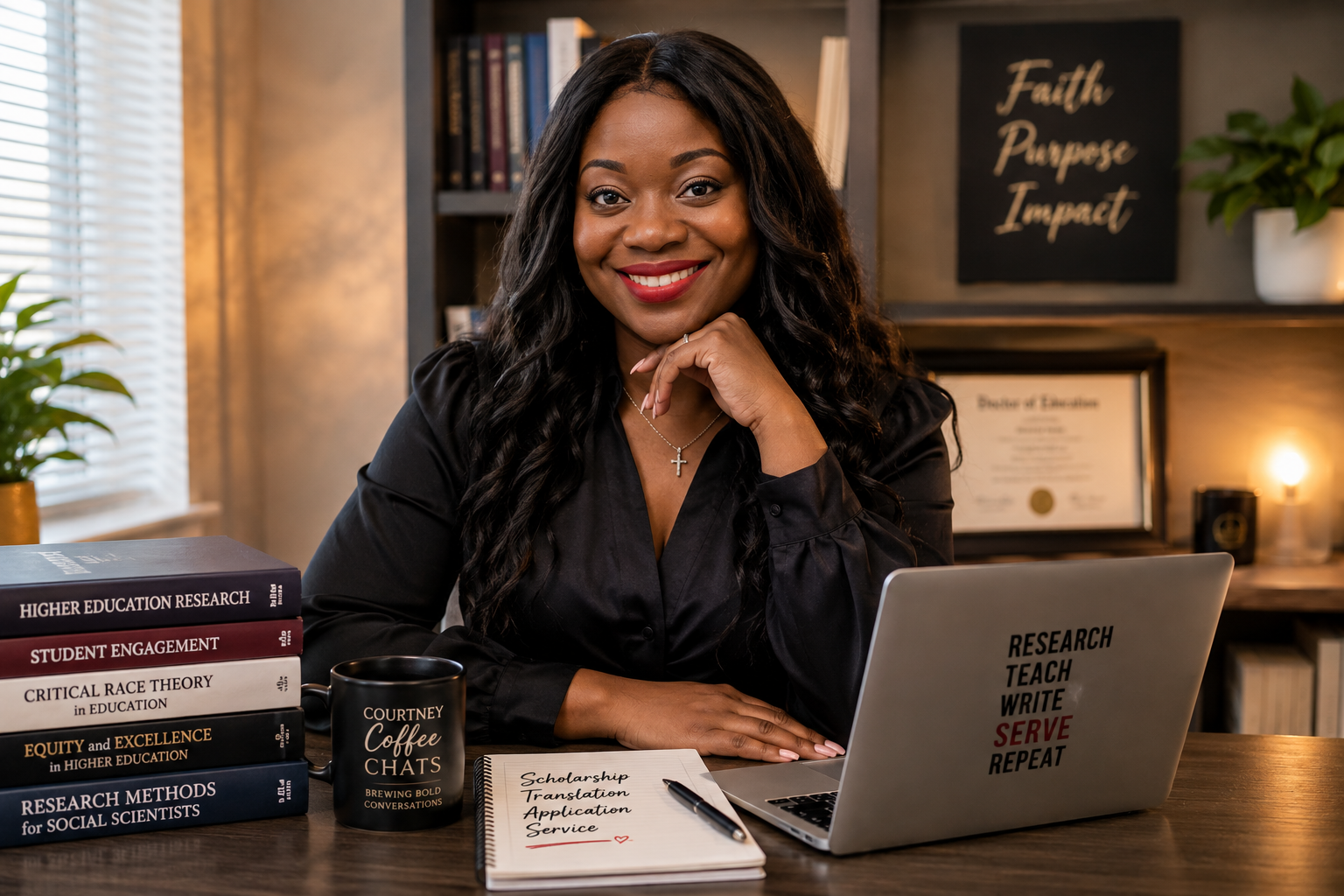
One year after successfully defending my dissertation, I am thinking less about what the degree gave me and more about what the work requires of me.
On August 29, 2025, I successfully defended my dissertation.
A year ago, so much of my attention was focused on reaching that moment. Could I finish? Could I defend the research I had spent months developing? Could I clearly articulate what I had learned and why it mattered?
One year later, I find myself asking a very different question:
What am I going to do with what I was entrusted to learn?
There is something different about standing on the other side of an accomplishment.
The degree has been conferred. The dissertation has been completed. The defense is no longer an approaching milestone on my calendar.
And yet, somehow, the work feels even more alive.
Perhaps that is because I am beginning to understand that the doctorate was never simply about earning another credential.
It was preparation.
It was stewardship.
And, in many ways, it was commissioning.
The Assignment Did Not End at the Defense
Over the past several weeks, I had every intention of following a carefully planned reflection calendar leading up to the anniversary of my dissertation defense.
Then life happened.
The Fall semester began, bringing new responsibilities. Several people passed away within a relatively short period of time. Conversations about legacy, grief, beginnings, faith, encouragement, and purpose began unfolding around me.
By the time I wrote my last reflection, Between Beginnings and Endings: What 72 Hours Taught Me About the Assignment, my attention had shifted.
I was no longer simply thinking about what the past year had taught me.
I was thinking about what I am supposed to do with what I have been given.
And maybe that was the reflection I needed all along.
I keep returning to 1 Peter 4:10:
“Each of you should use whatever gift you have received to serve others, as faithful stewards of God’s grace in its various forms.”
That verse has challenged me to think differently about scholarship.
What if the ability to research is a gift?
What if the ability to teach is a gift?
What if being able to recognize patterns, ask difficult questions, communicate ideas, write, present, and make meaning from lived experiences are all gifts entrusted to us?
Then perhaps the responsibility is not simply to possess those gifts.
Perhaps the responsibility is to use them in service to others.
When Research Leaves the Page
Academic scholarship matters.
Rigorous research matters.
Theory matters.
Peer review matters.
Dissertations, books, journal articles, conferences, and scholarly conversations all have important places within the production of knowledge.
But I increasingly find myself asking another question:
Who can use what we know?
A dissertation can remain in a repository.
An article can remain behind a journal paywall.
A conference presentation can exist for an hour in a ballroom.
A book can remain on a shelf.
But when scholarship becomes service, knowledge begins to travel.
Research becomes service when a student reads something and realizes, There is language for what I have been experiencing.
Research becomes service when a practitioner recognizes a pattern within their institution that they previously could not name.
Research becomes service when leaders are challenged to examine the distance between what their organizations say they value and what people actually experience.
Research becomes service when findings influence classrooms, programs, policies, practices, conversations, and decisions.
Research becomes service when complicated ideas are translated without being diminished.
Service does not require scholarship to become less rigorous.
It requires us to refuse to allow rigor to become isolation.
Scholarship, Translation, Application, Service
I am beginning to see my own work through a simple progression:
Scholarship → Translation → Application → Service
Scholarship helps us investigate.
Translation helps us communicate.
Application helps us move knowledge into practice.
Service asks us to consider who benefits because we did the work.
That final question matters to me deeply.
My research began with real people and real experiences. Participants trusted me with pieces of their stories. Their experiences helped illuminate questions about engagement, belonging, persistence, institutional responsibility, and what happens when students find themselves navigating environments that do not always respond to them with the care or accountability they deserve.
I do not believe receiving those stories gave me ownership over them.
It gave me responsibility.
And I increasingly believe that responsibility extends beyond citation.
If our research identifies barriers, inequities, institutional failures, possibilities, or pathways toward change, then we should be willing to ask what we are going to do with what we now know.
The Researcher Becomes Accountable to the Research
One of the unexpected shifts following my dissertation has been realizing that research can begin asking something of the researcher.
Once you see a pattern, it becomes difficult to pretend you did not see it.
Once people have trusted you with their experiences, it becomes difficult to treat those experiences as merely data.
Once your scholarship gives language to something happening around you, there is a responsibility to determine how that knowledge might contribute to something larger.
That does not mean every scholar must become an activist.
It does mean that I believe scholarship should make us accountable to the implications of what we discover.
For me, that has meant continuing to write.
Continuing to teach.
Continuing to present.
Continuing to study what is happening across higher education.
Continuing to develop ideas born from my research.
Continuing to connect scholarly frameworks with the experience’s students, employees, and institutions are navigating in real time.
And continuing to make portions of that work accessible outside traditional academic spaces.
CourtneyCoffeeChats has increasingly become one of those spaces for me.
What started as a place for reflection has also become a place where scholarship, faith, leadership, lived experience, and institutional critique can sit at the same table.
Maybe that, too, is part of the assignment.
For Such a Time as This
Esther 4:14 has remained close to me:
“And who knows but that you have come to your royal position for such a time as this?”
I think about that scripture differently now than I did before completing the doctorate.
“For such a time as this” does not necessarily mean receiving a platform.
Sometimes it means recognizing the responsibility attached to the platform you already have.
The classroom is a platform.
The page is a platform.
Research is a platform.
A conference room can be a platform.
A conversation can be a platform.
A blog can be a platform.
Sometimes service begins simply by asking:
What has God placed in my hands, and how can I use it well?
I do not believe every gift we receive is meant to terminate with us.
Some things are entrusted to us because they are supposed to travel through us.
One Year on the Other Side
A year ago, I was concerned with successfully defending the research.
Today, I am concerned with faithfully stewarding it.
That feels like growth.
Year One after the defense required me to learn that achievement does not protect us from adversity. It taught me about endurance, discernment, compassion, identity, faith, and the importance of continuing even when life does not look the way we anticipated.
Year Two feels different.
I am entering it asking fewer questions about proving myself and more questions about stewardship.
How can this research help someone?
How can this framework give language to an experience someone has struggled to explain?
How can my teaching make knowledge more accessible?
How can my writing challenge institutions while still pointing toward possibility?
How can what I have learned contribute to conversations larger than myself?
How can the work continue serving long after the dissertation defense is over?
Those are the questions I want guiding this next year.
Scholarship as an Act of Service
I want my scholarship to travel farther than my name.
I want the research to help someone understand what they have experienced.
I want my work to help institutions recognize what they may otherwise overlook.
I want my teaching to make knowledge accessible.
I want my writing to connect scholarship with lived experience.
I want the spaces I enter—classrooms, conferences, professional environments, churches, communities, and conversations—to leave with something useful.
Because if God entrusted me with the ability to research, teach, write, communicate, recognize patterns, and make meaning from what I encounter, then my responsibility cannot simply be to collect credentials around those gifts.
My responsibility is to put them to work.
One year after the defense, I am grateful for the degree.
But I am even more aware of the assignment.
The degree was an achievement.
The scholarship is an assignment.
And service is how I intend to steward it.
Remember, bold conversations, brewed fresh - one cup at a time!
Dr. Courtney Nicole Johnson
Founder of CourtneyCoffeeChats
Bold Conversations, Brewed Fresh.
Welcome to The Coffeehouse Collection - where higher education meets heart. Here, you will find Scholarly Sips, Courageous Cups, Life Latte Moments, and Freshly Brewed Reflections - bold conversation and personal insights brewed just for you!
